What Does Google Business Profile Optimization Actually Include?
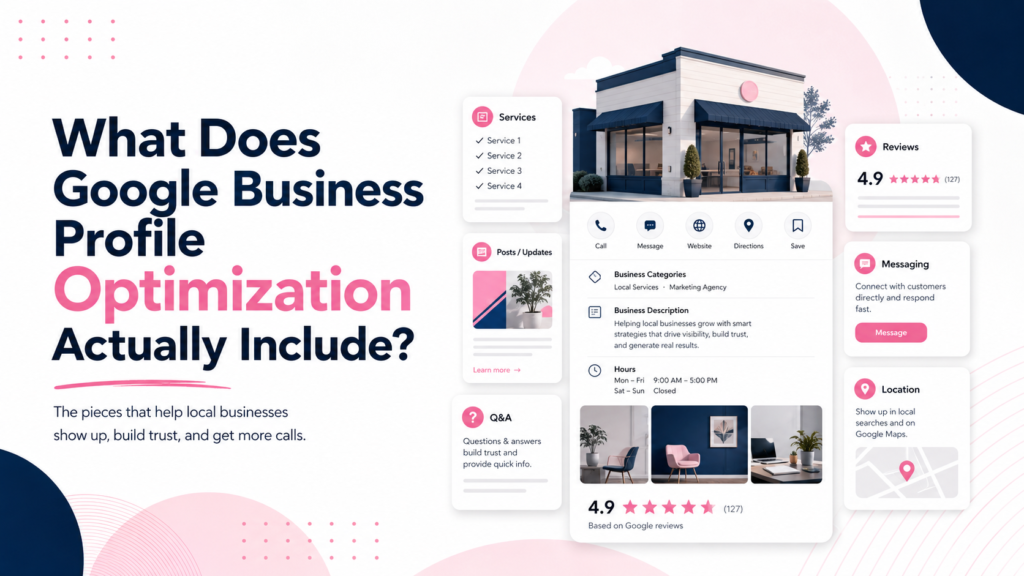
Most service businesses know they “should” have a Google Business Profile. Some have one sitting out there half-finished. A few have one that’s fully set up but hasn’t been touched in months.
What almost nobody knows is what Google Business Profile optimization actually means once the profile exists. Not the setup. The ongoing work that determines whether your listing shows up when someone searches for what you do, or whether it sits buried behind competitors who are doing more.
What does Google Business Profile optimization include?
Table of Contents
Google Business Profile optimization is the process of setting up, completing, and actively managing your business listing so it ranks higher in Google Search and Google Maps for the services you offer in the areas you serve. It includes accurate business information, strategic category selection, regular photo uploads, review management, weekly posts, and consistent updates that signal to Google your business is active and trustworthy.
That is the short answer. Here is what each piece actually involves, and why it matters.
Business information accuracy
This sounds basic, but it is where most listings fail. Your business name, phone number, address (or service area), website URL, and hours need to match exactly across every platform where your business appears. Google, Yelp, Bing, Facebook, Apple Maps, industry directories. If your phone number is (210) 555-1234 on Google and 210-555-1234 on Yelp and 2105551234 on your website, Google sees three different signals and trusts none of them.
NAP consistency (Name, Address, Phone) is not a suggestion. It is how Google verifies that your business is real and that the information it shows searchers is correct. One mismatch can suppress your listing in local results.
Category selection
Google lets you choose one primary category and multiple secondary categories. The primary category has the most weight on which searches your listing appears for. Most business owners pick whatever sounds closest and move on.
Google Business Profile optimization depends on choosing the right category. The right approach is to look at what your actual customers search for, check what categories your top-ranking competitors use, and select the primary category that matches the service generating your revenue. A plumber who also does HVAC repair should not have “home improvement” as their primary category.
Secondary categories expand your reach without diluting your primary ranking signal. Use them, but be specific. “Service business” tells Google nothing. “Plumbing service” tells Google exactly who should see your listing.
Photos and visual content
Google’s own data shows that businesses with photos receive 42% more requests for directions and 35% more click-throughs to their website than businesses without photos. That is not a vanity metric. That is the difference between a listing that converts and one that gets scrolled past.
Google Business Profile optimization means uploading real photos of your work, your team, your location (if applicable), and your results. Stock photos do not count. Google can detect stock images and they do not help your ranking. What helps is authentic visual proof that your business exists, does real work, and serves real customers.
Photo uploads should happen regularly, not once during setup and never again. A listing with photos from 2023 looks abandoned. Fresh photos signal that the business is active.
Review management
Reviews are the most visible trust signal on your profile. A business with 47 reviews and a 4.8 rating looks fundamentally different from a business with 3 reviews and a 5.0.
Google Business Profile optimization includes two parts: generating reviews consistently and responding to every single one. Not just the negative ones. Every review gets a response, ideally within 24 hours.
The response is not just politeness. It is content. Google reads review responses. A response that mentions the specific service you performed (“glad the GBP setup helped you start getting calls from Google Maps”) gives Google another signal about what your business does. Generic “thanks for the review!” responses waste that opportunity.
Review velocity matters more than total count. A business that gets 2-3 reviews per month signals ongoing activity. A business that got 20 reviews two years ago and nothing since signals a business that may not be operating at the same level.
Google Business Profile posts
Google Business Profile optimization treats posting as ongoing work. Posts are the most underused feature on GBP. Most businesses never post at all. The ones that do often post once during setup and forget about it.
GBP posts appear directly on your listing in Search and Maps. They can feature offers, updates, events, or general information about your services. Each post is an opportunity to include relevant keywords, link to your website, and show Google that your listing is actively maintained.
Google Business Profile optimizationThe optimization standard is at minimum one post per month. More is better if the content is relevant. A post about a service you actually provide, with a photo of real work, linking to the relevant page on your website, is more valuable than ten generic posts with stock images.
Service and product listings
Google lets you list specific services with descriptions. Most businesses either skip this entirely or list services with one-word descriptions that tell Google nothing.
Optimized service listings include the actual service name (matching what customers search for, not internal jargon), a description that explains what the service includes and who it is for, and pricing if applicable.
This is one of the easiest ranking signals to control. If you offer “Google Business Profile setup” as a service and a customer searches “google business profile setup near me,” having that exact service listed on your profile gives you a direct matching signal that competitors without it do not have.
Attributes and features
Google offers a growing list of business attributes: online appointments, free estimates, women-owned, veteran-owned, service options, accessibility features, and more. Each attribute you accurately claim adds specificity to your listing and can trigger your listing to appear for filtered searches.
Google Business Profile optimization includes claiming every relevant attribute. Many of these attributes go unclaimed because business owners do not know they exist. An optimized profile has every applicable attribute set.
What optimization is not
Google Business Profile optimization is not a one-time setup. A listing that was “optimized” in January and untouched since is no longer optimized. Google evaluates freshness, activity, and engagement continuously. Your competitors who are posting, collecting reviews, and uploading photos are sending stronger signals every day.
Google Business Profile optimization is also not keyword stuffing your business name. Google’s guidelines explicitly prohibit adding service keywords or location names to your business name (e.g., “Smith Plumbing – Best Plumber in Dallas” when the legal name is “Smith Plumbing”). This can get your listing suspended.
How to tell if your profile needs work
Pull up your Google Business Profile and check:
Is every section complete, including services, description, attributes, and hours?
When was your last post? If the answer is “I don’t know” or “months ago,” that is your answer.
How many reviews do you have from the last 90 days? If zero, your review velocity has stalled.
When did you last upload a photo? If you cannot remember, your listing looks stale to Google and to customers.
Does your phone number, address, and website URL match exactly across Google, your website, and other directories?
If any of these are gaps, those gaps are where your competitors are beating you.
What happens when optimization is done right
A fully optimized, actively managed Google Business Profile does three things: it shows up when customers search for your services, it builds trust before the customer ever visits your website or makes a call, and it drives measurable actions (calls, direction requests, website visits) that you can track.
For service businesses that depend on local customers finding them, this is not optional infrastructure. It is the foundation that everything else builds on.
Google Business Profile optimization starts with an honest assessment. If you want to know where your profile stands right now, start with a free visibility review. It takes a few minutes and shows you exactly what is working, what is missing, and what is costing you leads.